$19.99
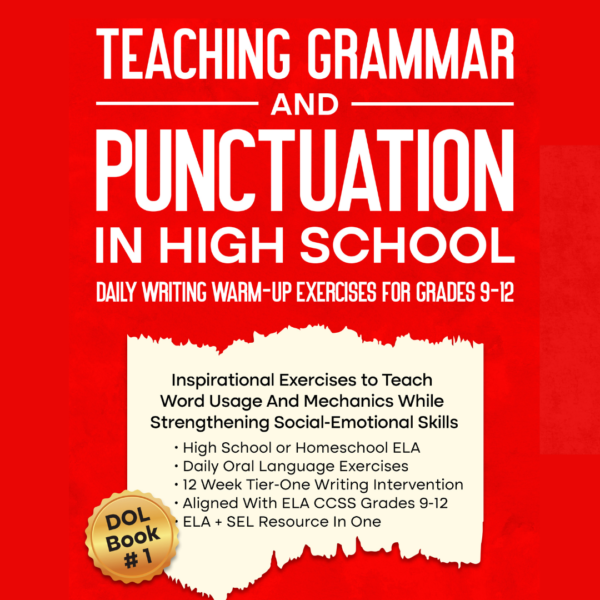
Grammar and Punctuation High School Bell Ringers Editing + SEL Life Skills EQ
Are your high school or homeschool students still confused when it comes to using commas, apostrophes, semicolons, and periods correctly? Can they capitalize when appropriate and differentiate between a dependent and an independent clause? Do they struggle with homophones or pronoun-antecedent agreement? Do you cringe at the thought of teaching grammar in isolation? If you’re a teacher or homeschooling parent tired of watching your students struggle with punctuation and word usage, this resource is for you.
This simple-to-use and effective writing resource is designed by a veteran special education and secondary ELA teacher who understands the necessity of quick, effective, and engaging writing exercises for secondary students.
I consistently emphasize to my high school students that writing well isn’t just an academic skill; it’s an empowering life skill that will significantly influence their futures, regardless of their paths. This is why I prioritize teaching and reviewing grammar and mechanics every day. The daily oral language (DOL) mini-lessons shared in this book are quick and effective, and students genuinely enjoy the activity.
On countless occasions, students have thanked me for taking the time to teach them the simple rules of writing that are often “skipped over” in secondary ELA classes. As high school teachers, we feel students should know the basic rules of writing at this stage, but the truth is, they don’t, and they don’t learn the rules by osmosis. Students need quick, engaging, and consistent direct instruction, and this resource makes it easy for everyone.
The grammar and punctuation exercises included in this resource seamlessly integrate social-emotional learning with writing instruction, and the results speak for themselves. Teachers around the globe are raving about finally finding an effective and engaging daily mini-lesson that teaches the rules of writing in a way students understand and genuinely enjoy!
This 12-week writing resource will change the way you and your students think about grammar and punctuation instruction. As a high school and Special Education teacher with more than a decade of experience in the secondary classroom, I’m well-versed in the woes of wading through poorly written assignments. I learned early in my career that high school students need direct daily instruction in grammar and mechanics. High school teachers often make the mistake of thinking students will learn the rules of writing within the context of their everyday reading and writing assignments, but this simply never happens. The five-minute exercises shared within this book explicitly teach students how to use grammar and punctuation correctly.
Embedded within the exercises are concepts rooted in positive psychology that foster metacognition and personal growth, and this is something students recognize and appreciate. By the end of twelve weeks, you will see a significant improvement in your students’ writing as well as their behavior.
Take your writing instruction to the next level while fostering academic excellence and personal growth with this teacher-designed resource.
CHECK OUT MY NEWEST RESOURCE: “PUNCTUATION POKER” GAME FOR GRADES 9-12 HERE
Download your FREE week of DOL exercises here: FREE DOL
FIND MY NEWEST DOL BUNDLE #2 PUBLISHED 08/22 HERE
*THIS RESOURCE IS INCLUDED IN MY YEAR-LONG ELA MEGA BUNDLE! FIND IT HERE
__________________________________________________________________
More About This Resource:
Includes 60 short Daily Oral Language (DOL) Paragraphs + Teacher Key + Bonus Mini-Lessons
These 60 short paragraphs align with the personal development principles addressed in Jay McGraw’s book Life Strategies for Teens, but this resource can certainly be used even if you’re not using his text.
Why DOL? Daily warm-ups or bell-ringers provide structure and predictability for students, which helps tremendously with behavior management. The first few minutes of class sets the tone for the remainder of the period, so having a meaningful daily activity to begin class sets the stage for success.
Moreover, throughout my 13 years in the secondary classroom, I found that most secondary students–even the best writers– need DIRECT DAILY INSTRUCTION with grammar and mechanics. Using these DOL paragraphs as part of your daily routine is a quick way to explicitly address the skill set that young writers so desperately need!
We learn through repetition, and daily DOL warm-ups will significantly improve your students’ writing skills! Students rarely receive explicit instruction with grammar and mechanics beyond elementary school, and as secondary teachers we often think they don’t need it, or we simply don’t have the time to address it in isolation. However, you’ll find these daily mini-lessons to be quick and–most importantly–effective!
In addition to strengthening your students’ writing skills, these daily mini-lessons allow you to address the social-emotional domain. Regardless of the subjects we teach, we all want our students to be socially and emotionally healthy, but we don’t all have the resources or time to teach SEL in isolation. Each daily DOL paragraph is based on modern neuroscience, positive psychology, and mindfulness and is intended to support students with their metacognitive growth. As a student of positive psychology for more than 20 years and a teacher of personal development for more than a decade, I have drawn upon years of research to create informative and inspirational daily paragraphs.
Implementing DOL:
PRE-ASSESSMENT: Sometimes (because they are a bit embarrassed to admit they need this instruction in high school) students initially object to this daily exercise. They might say it’s too remedial for them and insist they “already know this stuff.” Therefore, to justify doing it as a warm-up every day, and to nip the complaining in the bud, I have students complete the first paragraph independently as a pre-assessment. I tell them, “If you don’t need this instruction, show me you don’t need it, and we can skip it in the future.”
Then I collect them, grade these first paragraphs on my own (I use a quick 1-4 grading scale), record the grades so I can measure growth throughout the semester/year, and return them to students. I have NEVER, in my 13 years of teaching high school, found that students didn’t need this daily direct instruction. Upon receiving their graded initial assessments and seeing for themselves how much they need to learn, they will never argue again about doing the daily warm-up.
Ongoing Assessments: I use every Friday’s DOL as a quiz, and then record those grades so I can monitor growth. On the Monday following the quiz, we review correct answers together. These grades could be considered formative or summative, depending on your grading model. You might consider allowing students to review past DOL exercises or notes during the quizzes.
Introducing DOL to Students:
There are a couple ways to implement the activity. I begin by reviewing the What the Heck is a Clause? handout (included in this resource). Then, I project the DOL document onto the white board and give each student a paper copy of the DOL packet (or share the Google Doc with them and instruct them to edit with highlights). I give students two minutes to correct a paragraph on their own (one paragraph a day). Then, I make corrections on the board and have them follow along with me to ensure they made all necessary corrections. I tell them to use a colored pen or marker when correcting with me so I can quickly glance at their papers and see what they’re getting on their own and what they are needing help with. The entire activity shouldn’t take more than six to eight minutes.
Another idea is to have students come to the board to do the corrections. They will need guidance, and the activity will take a bit longer, but they love participating, and who doesn’t love writing on the board?! You can ask for volunteers or pull a name randomly out of a jar. They engage more if they know they may be called upon at some point to do the DOL in front of the class.
/5
Total reviews
|
|
Persons recommended this product
Anonymous
Shopper
check_circle Verified
Shop owner replied
Was this helpful
Anonymous
Shopper
check_circle Verified
Shop owner replied
Was this helpful
There are no reviews yet.
Be the first to review “ ”
Your feedback helps us improve our service.
Only logged in customers who have purchased this product may leave a review

,

Come for the Resources.
Stay for the Community.
2025 Copyright Tech and Mortar, LLC