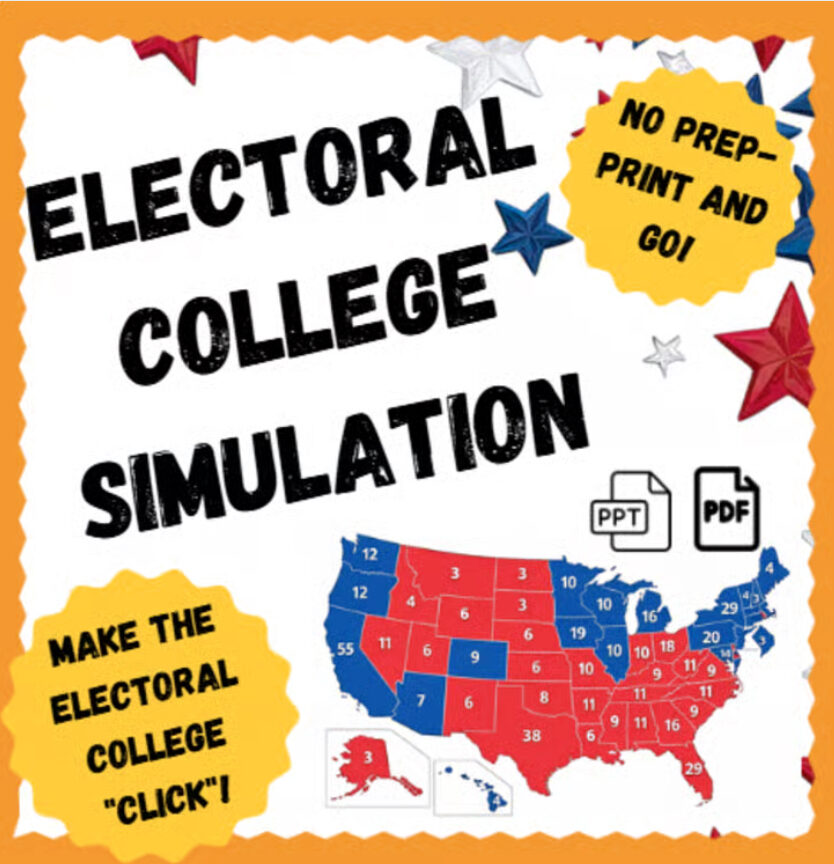
Electoral College Activity Game: Middle School Hands On Civics & Election 7-8
Make the Electoral College "Click" for Your Middle School Students!
Are your students confused about how a presidential candidate can win the popular vote but lose the election? Ditch the dry lectures and let them experience the system firsthand with this engaging, interactive Electoral College Simulation.
Designed specifically for Middle School Social Studies and Civics classes, this "Winner-Take-All" mock election activity uses a relatable sports analogy and a fun classroom role play to break down complex election concepts into a single 40-minute lesson.
Why Teachers Will Love This Activity:
- Zero Prep: Just print the ballots/signs and project the slides.
- Interactive: Gets students moving, voting, and calculating—no boring textbooks!
- Relevant: Perfect for Election Day, Constitution Day, or any Government unit.
- Scalable: Works for various class sizes by adjusting the population of the 4 "states."
What’s Included in This Resource:
Printable Simulation Materials:
- State Signs: Table labels for California, New York, Hawai'i, and North Dakota.
- Student Ballots: Ready-to-cut voting slips.
- Exit Tickets: A quick check for understanding where students identify pros and cons of the system.
- Teacher Script & Discussion Key: Exact wording to explain the math behind the "Winner-Take-All" rule.
Slideshow to Display Throughout the Activity:
Includes:
- Bellringer/ Warm Up activity
- Discussion Questions
- Materials for Simulation Activity
- Exit Ticket Question.
How It Works:
- The Hook: Start with a "World Series" baseball analogy. If Team A scores 10 runs in one game, but Team B wins the next four games by 1 run, who wins the series? (Hint: It’s the same logic as the Electoral College!) .
- The Setup: Divide your class into 4 uneven "states" based on population percentages (CA, NY, HI, ND).
- The Campaign: Students listen to 30-second speeches on fun topics (e.g., Pizza Party vs. Taco Party).
- The Vote: Students cast ballots. You tally the votes to demonstrate how winning a state by a landslide vs. winning by a single vote impacts the final Electoral College count.
- The Analysis: Students compare the Popular Vote vs. the Electoral Vote to see if the results match.
Learning Objectives:
- Understand the System: Students will demonstrate how the "Winner-Take-All" system works by calculating vote totals.
- Analyze Strategy: Explain why candidates focus on "swing states" and why small states (like North Dakota) value the system.
- Critical Thinking: Evaluate the fairness of the Electoral College by identifying positives (protecting small states) and negatives (popular vote disparities) .
Why Teachers Will Love This Activity:
- Zero Prep: Just print the ballots/signs and project the slides.
- Interactive: Gets students moving, voting, and calculating—no boring textbooks!
- Relevant: Perfect for Election Day, Constitution Day, or any Government unit.
- Scalable: Works for various class sizes by adjusting the population of the 4 "states."
Questions about this resource
Wondering if this is the right fit before you buy? See what other shoppers asked, or ask Leah your own. You don’t need to have bought anything.
Sign in to ask a question
Sign in so Leah’s answer can reach you. You don’t need to have bought anything from History With Ms. Leah.
No reviews yet — be the first to leave one.

Hello! My name is Leah. I am a middle school social studies teacher. I have been teaching for 7 years, and have taught 6th, 7th, and 8th grade social studies, and one year of Digital Citizenship.
I have a passion for creating engaging lesson that challenge students to critically think, collaborate, and grow as learners.