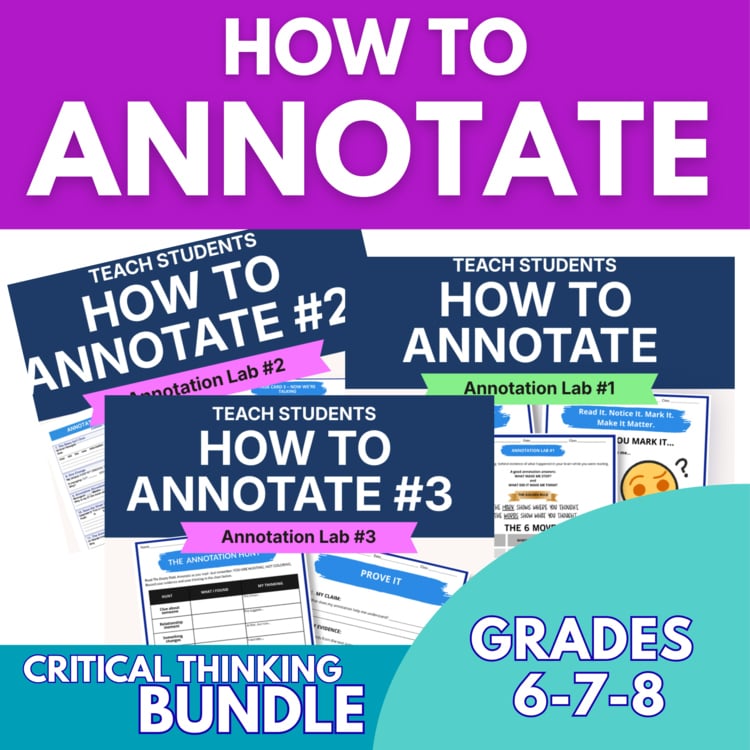
What's in This Bundle (3 resources)
Every resource is also available on its own.
$10.50 bundle · $13.50 value · Save 22%
Resource Type · Bundle
Annotation Labs Bundle | 3 Engaging Lessons for Purposeful, Close Reading
$10.50
Meet the Seller
Annotation Labs Bundle | 3 Engaging Lessons for Purposeful Reading, Close Reading & Critical Thinking
Stop highlighting. Start thinking!
Are your students actually thinking when they annotate, or are they simply coloring the page?
This three-part Annotation Labs Bundle transforms annotation from a routine marking activity into a powerful tool for critical thinking, close reading, and evidence-based analysis.
Students won't just learn HOW to annotate. They'll learn WHAT deserves their attention, WHY it matters, and HOW to defend their thinking using textual evidence.
Through engaging challenges, task cards, an annotation hunt, and opportunities for discussion, students gradually build the skills needed to become more thoughtful, independent readers.
Three labs. Three essential skills. One goal: Make every annotation matter!
WHAT'S INCLUDED?ANNOTATION LAB #1
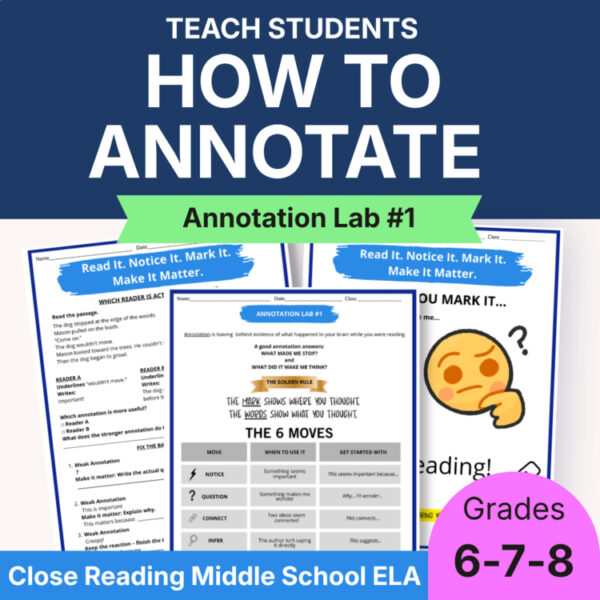
Read It. Notice It. Mark It. Make It Matter.
Build the foundation for meaningful annotation.
Before students can annotate effectively, they need to understand what annotation is actually supposed to accomplish.
In this introductory lab, students discover that annotation isn't about collecting symbols or highlighting everything that looks important. It's about leaving evidence of their thinking while they read.
Students will:
- Explore six essential Annotation Moves: Notice, Question, Connect, Infer, Track, and React.
- Examine weak and strong annotations.
- Practice turning simple marks into meaningful thinking.
- Create their first purposeful annotations.
THE BIG IDEA: Good readers don't annotate everything. They annotate what makes them stop and think.
ANNOTATION LAB #2
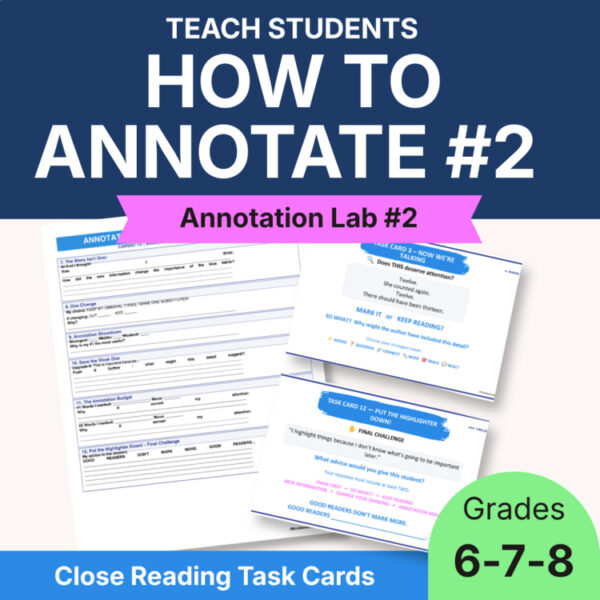
Put the Highlighter Down! | 12 Critical Thinking Task Cards
Learn to make thoughtful annotation decisions.
Now that students understand purposeful annotation, it's time to make them choose!
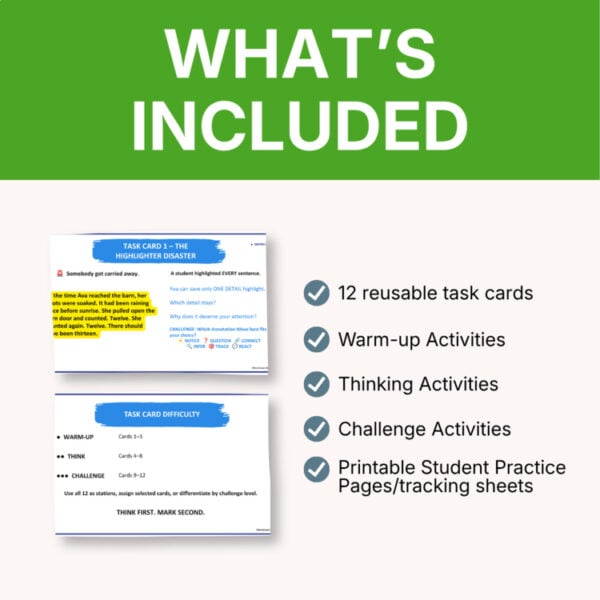
Through 12 progressively challenging task cards, students learn that not every sentence deserves a highlight—and that sometimes the smartest reading decision is to keep reading.
Students will:
- Rescue important details from an over-highlighted passage.
- Decide which information deserves their attention.
- Work within an annotation budget.
- Defend their choices and make difficult cuts.
- Reconsider earlier decisions when new evidence emerges.
- Evaluate and strengthen weak annotations.
The cards are organized into three levels: Warm-Up, Think, and Challenge, making them ideal for differentiation, collaborative learning, or independent enrichment.
THE BIG IDEA: Think first. Mark second.
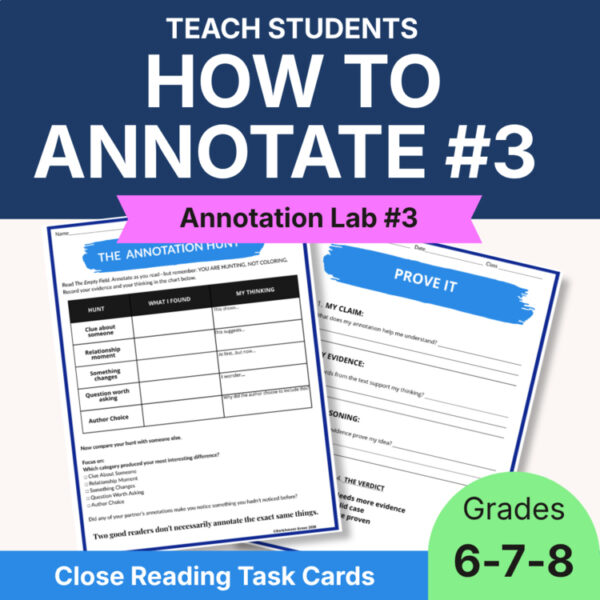
ANNOTATION LAB #3
Find It. Think About It. Prove It. | The Annotation Hunt
Turn annotations into evidence-based analysis.
Students have learned to annotate and make thoughtful choices. Now it's time to put those skills to work!
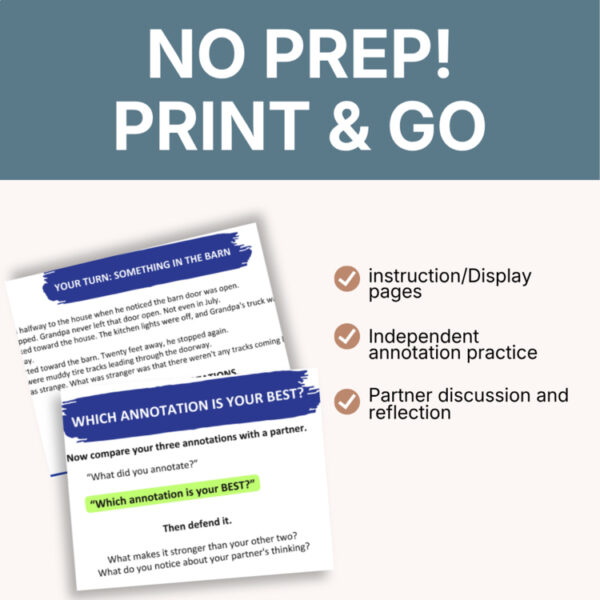
Using an original, suspenseful practice passage, students become reading detectives, hunting for meaningful details that reveal character, relationships, changes, questions, and author's choices.
But finding an annotation is only the beginning.
Students will:
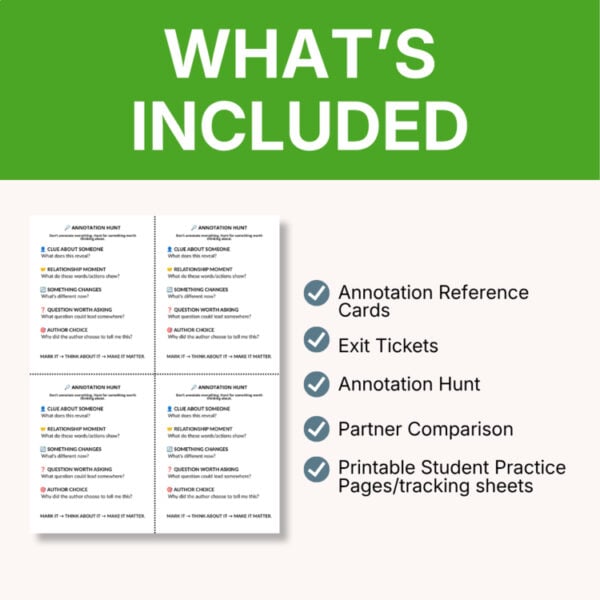
- Complete a five-category Annotation Hunt.
- Compare their discoveries with a partner.
- Select and evaluate their strongest annotation.
- Develop a claim about what their annotation reveals.
- Support their interpretation with textual evidence.
- Explain the reasoning that connects their evidence to their claim.
Reusable Annotation Hunt reference cards allow students to transfer these skills to future reading assignments.
THE BIG IDEA: Find it. Think about it. Prove it.
WHY TEACHERS WILL LOVE THIS BUNDLE
A purposeful progression: Each lab builds on the previous one, moving students from basic annotation skills toward independent, evidence-based analysis.
Critical thinking at every stage: Students must explain their decisions, evaluate their own work, consider alternative interpretations, and support their conclusions.
Flexible implementation: Use the labs as a complete introductory annotation unit or incorporate individual activities throughout the school year.
Built-in differentiation: The varied challenges provide opportunities to support developing readers while extending the thinking of advanced and gifted students.
Transferable skills: Students can apply the strategies to novels, short stories, informational texts, literature circles, and independent reading.
PERFECT FOR
- Middle school ELA, grades 6–8
- Introducing or reviewing annotation strategies
- Close reading and reading comprehension
- Small-group discussions and literacy stations
- Gifted and advanced ELA enrichment
- Developing claim, evidence, and reasoning skills
- Preparing students for literary analysis
THE ANNOTATION LABS PROGRESSION
LAB 1: LEARN IT.
Discover what meaningful annotation looks like.
LAB 2: CHOOSE IT.
Decide what deserves attention and defend your choices.
LAB 3: PROVE IT.
Use annotations to develop and support deeper interpretations.
By the end of these three labs, students will have practiced a complete process for purposeful reading:
NOTICE → THINK → ANNOTATE → EVALUATE → SUPPORT WITH EVIDENCE
Give your students more than a highlighter and a list of symbols. Give them the tools to think deeply about what they read—and the confidence to explain and defend their thinking.
READ IT. NOTICE IT. MARK IT. MAKE IT MATTER.
Format
PDF
✓ Systematically guides students through the process of annotating
✓ Independent and group activities
✓ Opportunities for student practice and discussion
✓ Built in differentiation
✓ Flexible use
✓ Helps develop claim, evidence and reasoning skills
✓ Slide show/notes/activities
✓ task cards
✓ exit tickets
✓ leveled challenges
READ IT. NOTICE IT. MARK IT. MAKE IT MATTER. Give your students more than a highlighter and a list of symbols. Give them the tools to think deeply about what they read—and the confidence to explain and defend their thinking.
My students highlight everything! Will these activities help?
That's exactly the kind of problem our Annotation Labs are designed to address! Rather than treating annotation as simply highlighting or underlining, students learn to make purposeful decisions about what matters in a text and why.
Do students need prior experience with annotation?
Not necessarily. Some activities introduce foundational annotation skills, while others encourage students to evaluate, explain, and deepen their annotations. Check the individual lab descriptions to choose the best starting point.
Are Annotation Labs just worksheets?
No! Our goal is to make annotation an active thinking process rather than a mechanical task. Depending on the lab, students may evaluate choices, defend decisions, analyze evidence, or discuss alternative interpretations.
Are the Annotation Labs appropriate for gifted learners?
Absolutely! Annotation becomes much more challenging when students must justify their decisions, examine subtle details, and consider multiple interpretations. These activities encourage the deeper reasoning that advanced learners need.
Can I use the Annotation Labs in any order?
The labs are designed to develop related annotation and analytical thinking skills. They can be used together as a series or individually to target particular skills. Teachers can choose the sequence that best meets their students' needs.
Questions
Questions about this resource
Wondering if this is the right fit before you buy? See what other shoppers asked, or ask Stephanie your own. You don’t need to have bought anything.
Sign in to ask a question
Sign in so Stephanie’s answer can reach you. You don’t need to have bought anything from Enrichment Grove.
What Teachers Are Saying
No reviews yet — be the first to leave one.
Stay in the Loop
Join the Enrichment Grove Email List

Enrichment Grove
✦ PRO
With 39 years in the classroom, Stephanie has spent nearly four decades learning what actually works for middle schoolers — and what doesn't.
She began her career as an Intervention Specialist before earning her Master's degree in Reading from Ashland University and transitioning into Reading and Language Arts, where she has focused much of her career on gifted and advanced learners. She holds a Gifted Intervention Specialist endorsement from Drake University and completed her undergraduate degree at Wittenberg University.
Over the years, Stephanie has taught in a wide range of school districts, working with an equally wide range of learners — different backgrounds, different ability levels, different needs. That journey shaped the core belief behind her teaching (and now her resources): all children, regardless of background or ability, learn best through enriching, creative activities that challenge them without burning them out.
Stephanie is the creator of Enrichment Grove, where she brings that philosophy to teachers and homeschool families through rigorous, engaging ELA resources.
Outside the classroom, Stephanie is married and the proud (and slightly battle-tested) parent of five children — all of whom have survived their teenage years, as has she. When she's not teaching or creating, you'll find her on the golf course, in the kitchen, or at the beach.
Join the Enrichment Grove Email List
More from this Store
Shop Now →
Live Well · Teach Well
Shop TeacherStore Goods