You May Also Like
Suggested Resources by Enrichment Grove
Subject · ELA
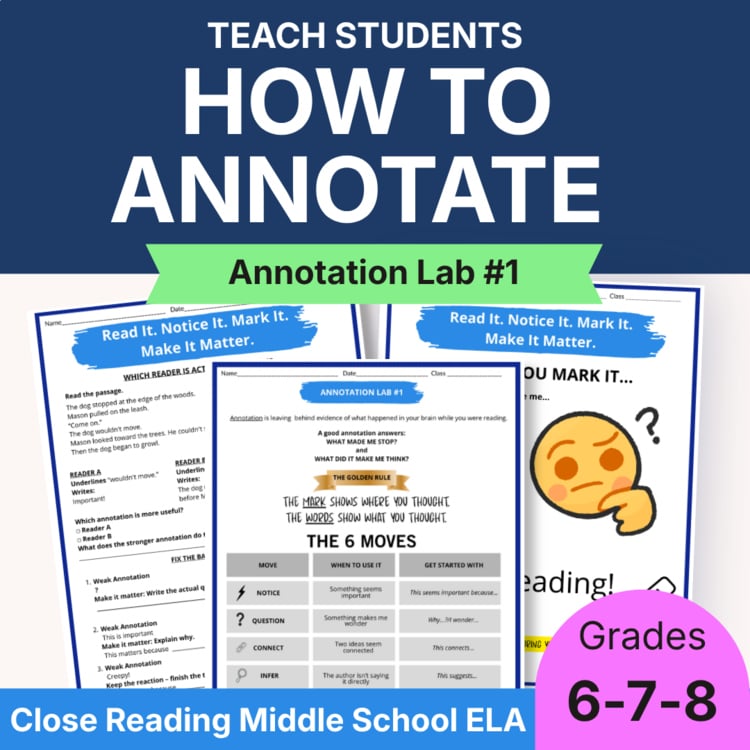
Annotation Lab #1 | Teach Students How to Annotate | Close Reading Middle School
$4.50
Also in a bundle
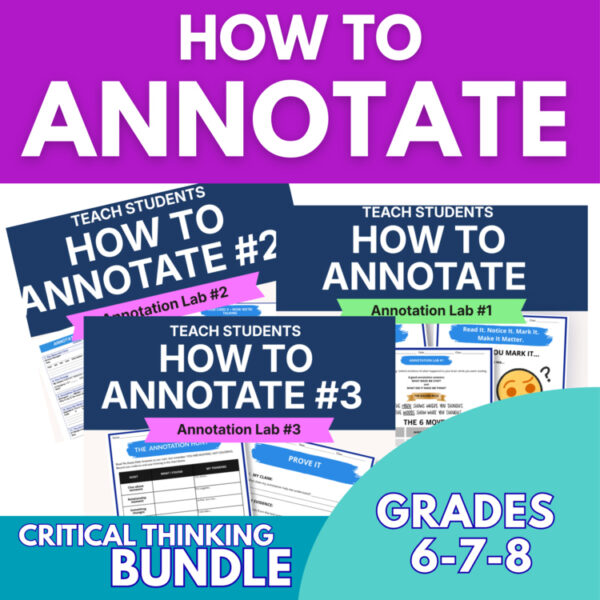
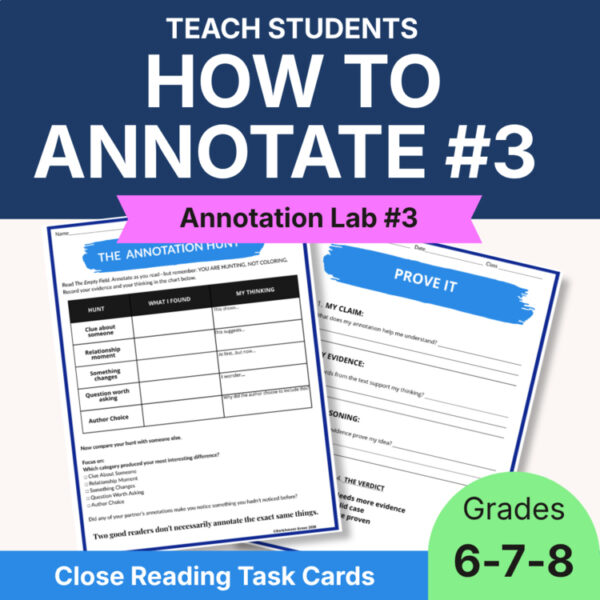
Annotation Labs Bundle | 3 Engaging Lessons for Purposeful, Close Reading
· 3 resources · save 22% →
Meet the Seller
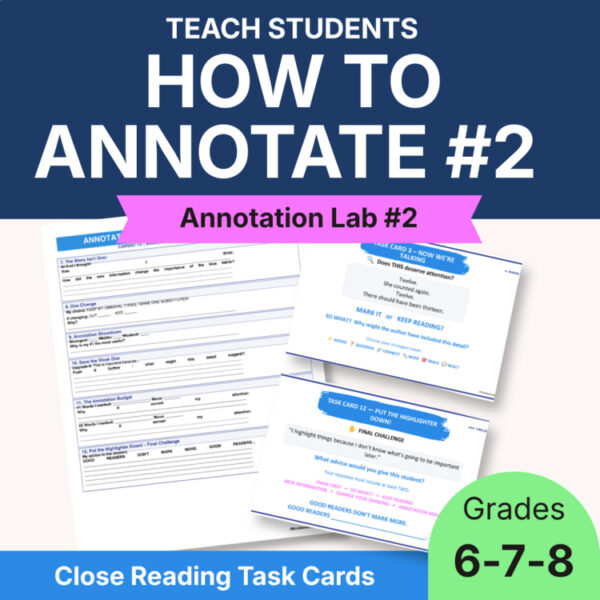
Annotation Lab #1: Read It. Notice It. Mark It. Make It Matter.
Are your students highlighting half the page, circling random words, or writing “important!” in the margin without being able to explain why?
They may know how to mark a text—but they haven't learned how to make their thinking visible.
Annotation Lab #1 introduces students to annotation in a simple, student-friendly way:
Good readers don't annotate everything. They annotate what makes them stop and think.
Instead of giving students a complicated list of annotation symbols to memorize, this lesson teaches them to recognize the moments when a text causes them to notice, wonder, connect, infer, track a pattern, or react. Students then learn to add words that explain the thinking behind the mark.
Students learn 6 practical Annotation Moves:
- ⚡ NOTICE — Something seems important.
- ? QUESTION — Something makes me wonder.
- 🔗 CONNECT — Two ideas seem connected.
- 🔍 INFER — The author isn't saying it directly.
- ◎ TRACK — I'm noticing a pattern or change.
- 💬 REACT — A genuine reaction.
But students don't stop with a symbol or one-word reaction.
The guiding principle throughout the lesson is:
The mark shows WHERE you thought.
The words show WHAT you thought.
Students examine weak and strong annotations, revise unfinished annotations, practice expanding one-word reactions, and ultimately create and defend their own annotations.
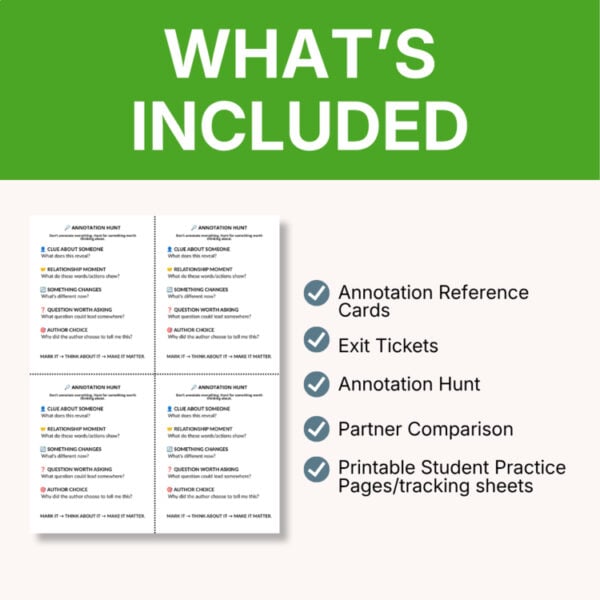
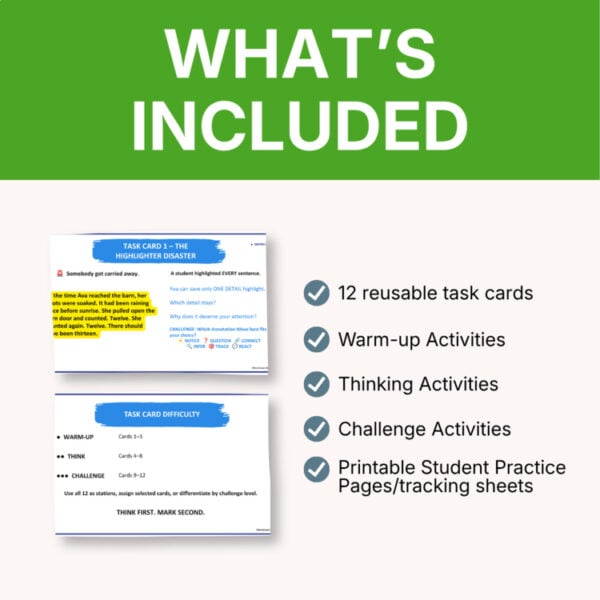
What's Included
This resource includes:
- Student-friendly introduction to annotation
- The 6 Annotation Moves
- Annotation reference page
- “Before You Mark It” decision guide
- Strong vs. weak annotation comparison
- Fix the Bad/Weak Annotations practice
- “Don't Stop at One Word” strategy
- Original practice reading passage
- Independent annotation practice
- Partner discussion and reflection
- Exit ticket
- Instructional/display pages for teacher modeling and whole-class instruction
- Printable student practice pages
Why Teachers Will Love It
This lesson doesn't teach students to decorate a text with highlighters. It teaches them to leave evidence of their thinking while they read.
Students learn that “Interesting,” “Important,” “Creepy!” and a question mark can be perfectly good starting points—but they aren't finished annotations until the reader explains the thinking behind them.
The activities are short, approachable, and designed to generate discussion without overwhelming students with complicated annotation codes.
Perfect For
Middle School ELA • Grades 6–8 • Close Reading • Novel Studies • Short Stories • Independent Reading • Reading Workshop • Literature Circles • Back to School • Annotation Introduction • Reading Strategies
Use Annotation Lab #1 before beginning a novel study, at the start of the school year, as a reading-strategy mini-unit, or anytime students need a reset on what meaningful annotation actually looks like.
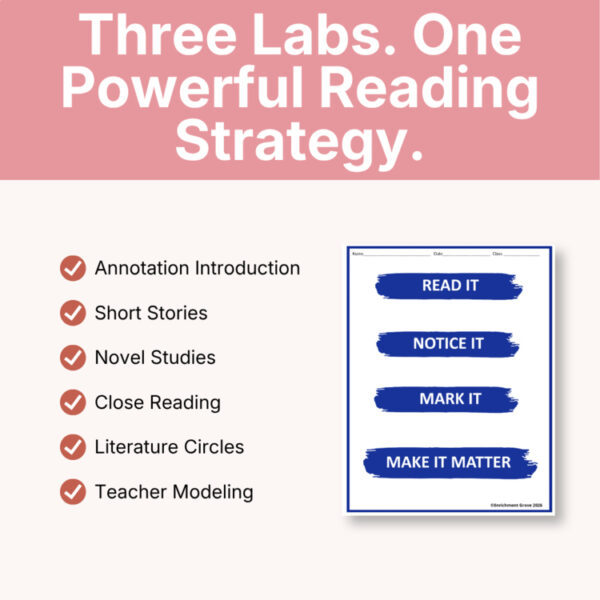
Read It. Notice It. Mark It. Make It Matter.
Format
PDF
✓ Evidence of Thinking
✓ Short, Approachable Activities
✓ Use throughout the year
✓ NO DECORATING TEXT WITH HIGHLIGHTERS!
✓ Student-friendly introduction to annotation
✓ The 6 Annotation Moves/Annotations Reference Page
✓ "Don't Stop at One Word" Strategy
✓ Before You Mark It” decision guide
✓ Strong vs. weak annotation comparison
✓ Fix the Bad/Weak Annotations practice/Exit Ticket
So many students think annotating is decorating a text with highlighters. This teaches them to leave evidence of their thinking while they read. Students learn that “Interesting,” “Important,” “Creepy!” and a question mark can be perfectly good starting points, but they aren't finished annotations until the reader explains the thinking behind them.
What grade level is this best for?
This was created for students in grades 5-9, with a target range 6-8.
Can this be done independently?
Yes, there is a slide show and activities that can be done and checked.
Questions
Questions about this resource
Wondering if this is the right fit before you buy? See what other shoppers asked, or ask Stephanie your own. You don’t need to have bought anything.
Sign in to ask a question
Sign in so Stephanie’s answer can reach you. You don’t need to have bought anything from Enrichment Grove.
What Teachers Are Saying
No reviews yet — be the first to leave one.
Stay in the Loop
Join the Enrichment Grove Email List

Enrichment Grove
✦ PRO
With 39 years in the classroom, Stephanie has spent nearly four decades learning what actually works for middle schoolers — and what doesn't.
She began her career as an Intervention Specialist before earning her Master's degree in Reading from Ashland University and transitioning into Reading and Language Arts, where she has focused much of her career on gifted and advanced learners. She holds a Gifted Intervention Specialist endorsement from Drake University and completed her undergraduate degree at Wittenberg University.
Over the years, Stephanie has taught in a wide range of school districts, working with an equally wide range of learners — different backgrounds, different ability levels, different needs. That journey shaped the core belief behind her teaching (and now her resources): all children, regardless of background or ability, learn best through enriching, creative activities that challenge them without burning them out.
Stephanie is the creator of Enrichment Grove, where she brings that philosophy to teachers and homeschool families through rigorous, engaging ELA resources.
Outside the classroom, Stephanie is married and the proud (and slightly battle-tested) parent of five children — all of whom have survived their teenage years, as has she. When she's not teaching or creating, you'll find her on the golf course, in the kitchen, or at the beach.
Join the Enrichment Grove Email List
More from this Store
Shop Now →
Live Well · Teach Well
Shop TeacherStore Goods