

You May Also Like
Suggested Resources by Digital Citizen Universe
Subject · AI Tools
Fact-Check Field Guide + The Unfair App Store • AI Fact-Checking and Bias Activities, Grades 5-7
$3
Also in a bundle
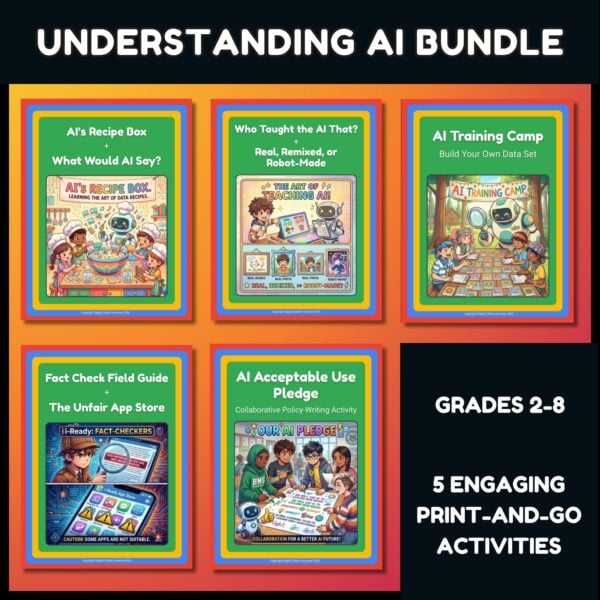
Google Be Internet Awesome AI Companion Bundle | AI Literacy Grades 2-8
· 5 resources · save 33% →
 Your students know AI can make mistakes. Can they catch one?
This set has two screen-free activities for grades 5-7 about what happens when AI gets it wrong.
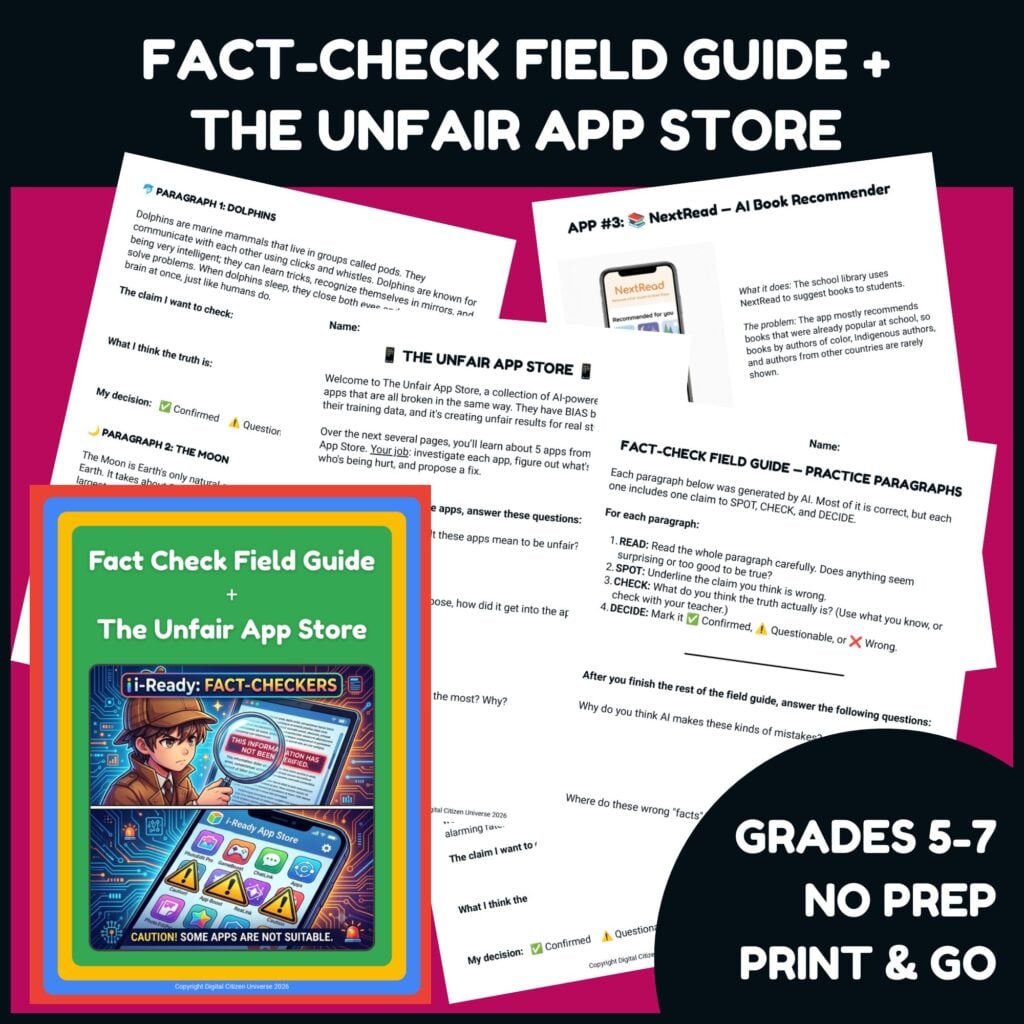
 Fact-Check Field Guide (20 to 25 minutes)
Students learn four steps for checking AI output: READ, SPOT, CHECK, DECIDE. Then they practice on six short paragraphs about dolphins, the Moon, octopuses, lightning, dogs, and rainforests. Each paragraph is mostly right, with one claim that sounds true and isn't:
 Dolphins rest their whole brain when they sleep, just like people.
 The Moon is the largest moon in the solar system.
 Octopuses have 10 arms.
 Lightning never strikes the same place twice.
 Dogs only see in black and white.
 The Amazon produces 50% of the world's oxygen.
The answer key explains the truth behind each one and why an AI might repeat the mistake.
 The Unfair App Store (20 to 25 minutes)
Students visit a made-up app store where every school app has the same problem: biased training data. A grading app marks down Maria because her sentences reflect Spanish at home. A recess app only suggests activities that match gender stereotypes. A book app keeps leaving out authors of color. A music app guesses taste from a student's name. A "Star Student" picker rewards sitting quietly. For each app, students name the bias, who it hurts, and one change that would make it fairer.
Everything is on paper, and the two activities work together in one class period or on separate days. The Activity Guide includes notes for doing them at home, one paragraph or one app at a time.
 Use it on its own or as a companion
You don't need any other curriculum to use these activities. If you teach Google Be Internet Awesome: Understanding AI, they give students hands-on practice with Lesson 3, "Responsible AI Use," and its ideas about fact-checking AI and bias.
 Part of the Be Internet Awesome AI Companion Bundle
This is one of five AI literacy activities for grades 2-8 in my Be Internet Awesome AI Companion Bundle. Get all five for $10 instead of $15.
 Standards Connections
Connects to ISTE 1.3b (Knowledge Constructor): students evaluate the accuracy and credibility of AI-generated information.
Connects to CSTA MS-ALG-IM-10 and MS-DAT-IM-29 (2026) and their closest 2017 code, 2-IC-21: students examine bias in apps and trace how choices about data lead to unfair results.
Connects to CSTA E5-DAT-IM-11 (2026) and its closest 2017 code, 1B-IC-19: students weigh the benefits and risks of apps that use collected data and propose ways to make them work for more users.
This resource is not affiliated with, endorsed by, or sponsored by Google. Be Internet Awesome is a program of Google (https://beinternetawesome.withgoogle.com).
 Join the Digital Citizen Universe
Want help teaching your kids and students to be thoughtful digital citizens? Join my email list with the form in the sidebar, and you'll be the first to hear about new resources. Questions? Email hello@digitalcitizenuniverse.com.
Format
PDF
✓ A 4-step fact-checking process students can reuse
✓ Six false claims hidden in mostly true paragraphs
✓ Five made-up apps based on real AI bias problems
✓ Answer key explains why AI makes each mistake
✓ Works for CS, advisory, and ELA classes
✓ No devices or internet needed
✓ 1-page Activity Guide with classroom and home notes
✓ 4-page Practice Paragraphs packet with the 4-step guide
✓ Fact-Check answer key with "Why AI Gets This Wrong"
✓ 6-page App Investigation packet with five apps
✓ 2-page Unfair App Store Discussion Guide
✓ Reflection questions for both activities
Do students need devices or AI accounts?
No. Everything is on paper. For the fact-checking, you, a textbook, or what students already know can be their second source.
Do I need to teach Google Be Internet Awesome first?
No. The Activity Guide introduces fact-checking, training data, and bias, so the activities work on their own.
Are the apps real?
No. All five are made up for this activity, but each one is based on a kind of bias that has shown up in real AI tools.
Can I use this at home?
Yes. Do one paragraph or one app a day and talk it through together. Looking up the claims together makes a good second source.
Questions
Questions about this resource
Wondering if this is the right fit before you buy? See what other shoppers asked, or ask Elizabeth your own. You don’t need to have bought anything.
Sign in to ask a question
Sign in so Elizabeth’s answer can reach you. You don’t need to have bought anything from Digital Citizen Universe.
What Teachers Are Saying
No reviews yet — be the first to leave one.
Stay in the Loop
Join the Digital Citizen Universe Email List
More from this Store
Shop Now →
Live Well · Teach Well
Shop TeacherStore Goods