
You May Also Like
Suggested Resources by Digital Citizen Universe
Subject · AI Tools
AI Training Camp • Build Your Own Data Set: Unplugged AI Bias Activity for Grades 4-6
$4
Also in a bundle
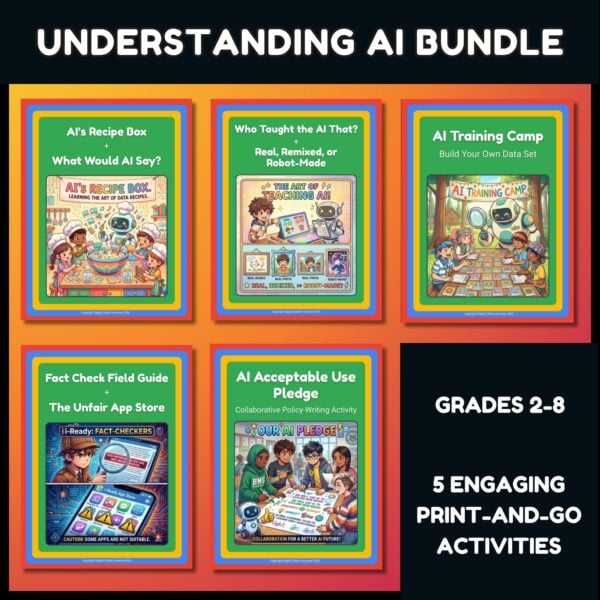
Google Be Internet Awesome AI Companion Bundle | AI Literacy Grades 2-8
· 5 resources · save 33% →
 What happens when an AI only learns from some of the animals?
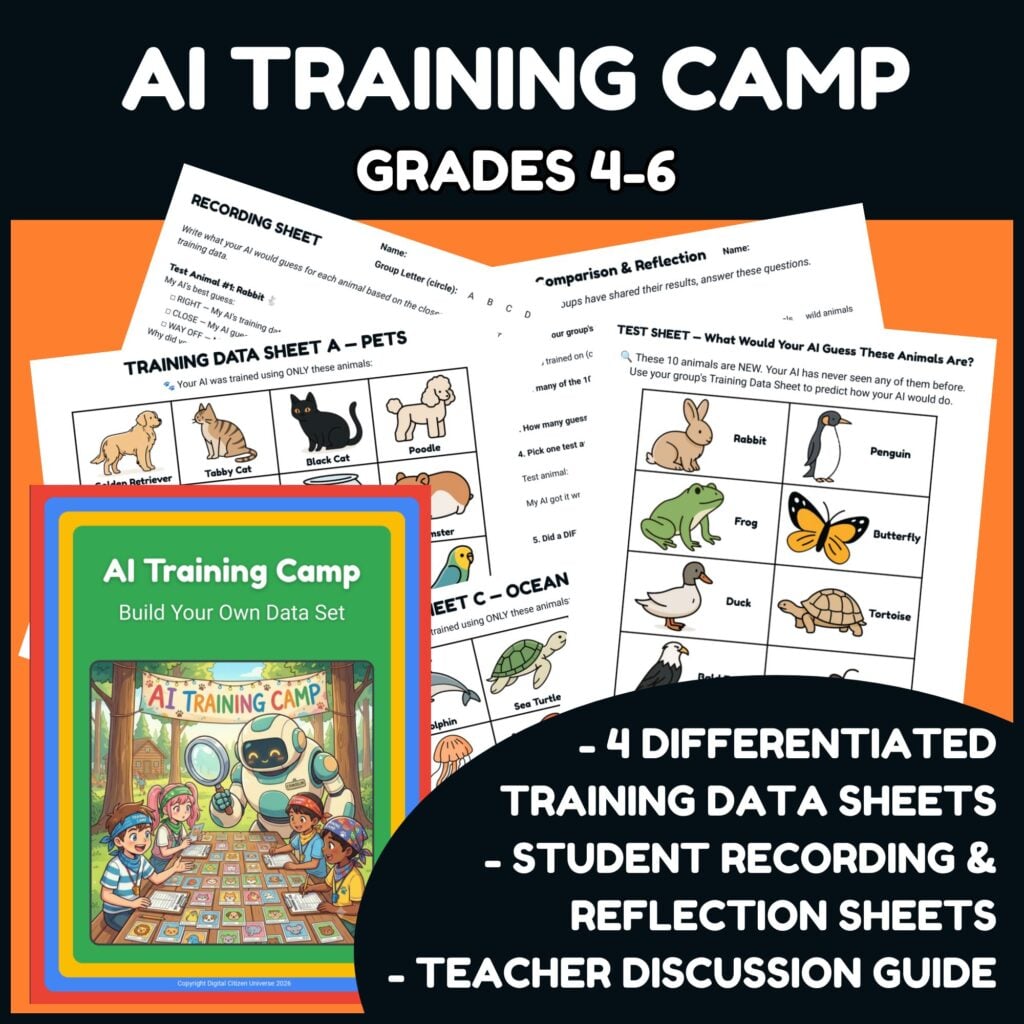
In AI Training Camp, students become AI trainers. Each group gets a different set of 12 animal cards as its AI's training data: pets, farm animals, ocean animals, or wild animals. Groups don't see each other's sheets. Then every group tests its AI on the same 10 new animals.
Each group works through four rounds:
 Study the data: groups look at their 12 animals and talk about what they have in common and what's missing.
 Test the AI: students predict their AI's best guess for each new animal and rate it RIGHT, CLOSE, or WAY OFF. They work with the rule picture-sorting AI follows: it almost never says "I don't know." It reaches for the closest thing it has seen.
 Compare: same mission, same test, very different answers. The ocean AI calls a tortoise a sea turtle. The wild animals AI calls a panda a bear, the best guess of any group. No group's AI recognizes the butterfly, because no group had an insect.
 Reflect: students connect their results to real AI and take on a bigger question. If you combined all four data sets, would that fix it?
It's print-and-go, screen-free, and fits in one class period (30 to 40 minutes). It works with 2 to 8 groups, and the Activity Guide includes notes for using it at home with one or two kids.
 Use it on its own or as a companion
You don't need any other curriculum to use this activity. If you teach Google Be Internet Awesome: Understanding AI, it gives students hands-on practice with Lesson 1, "What is AI?", and Lesson 3, "Responsible AI Use."
 Part of the Be Internet Awesome AI Companion Bundle
This is one of five AI literacy activities for grades 2-8 in my Be Internet Awesome AI Companion Bundle. Get all five for $10 instead of $15.
 Standards Connections
Connects to CSTA E4-ALG-ML-02 (2026) and its closest 2017 code, 1B-DA-07: students link what's in their training data to the guesses their AI makes.
Connects to CSTA MS-ALG-ML-06 (2026): students form a theory about how their AI decides what a new animal is. AI is new to the 2026 standards, and the closest 2017 code is 1B-DA-07, using data to predict outcomes.
Connects to CSTA MS-ALG-ML-07 (2026) and its closest 2017 codes, 2-DA-09 and 2-IC-21: students look for ways to improve their AI's accuracy and reduce bias by changing its training data, and discuss how bias gets into technology.
Also connects to ISTE 1.3d (Knowledge Constructor).
This resource is not affiliated with, endorsed by, or sponsored by Google. Be Internet Awesome is a program of Google (https://beinternetawesome.withgoogle.com).
 Join the Digital Citizen Universe
Want help teaching your kids and students to be thoughtful digital citizens? Join my email list with the form in the sidebar, and you'll be the first to hear about new resources. Questions? Email hello@digitalcitizenuniverse.com.
Format
PDF
✓ Students discover AI bias by testing their own "AI"
✓ Four different data sets and one shared test
✓ Sample guesses for every group and test animal
✓ Print-and-go, screen-free, one class period
✓ Works with 2 to 8 groups
✓ Home notes for one or two kids
✓ 1-page Activity Guide with classroom and home notes
✓ 4 Training Data Sheets with 12 animal cards each
✓ Test Sheet with 10 new animals
✓ 2-sided Recording Sheet
✓ 2-sided Mission Briefing and Group Comparison & Reflection
✓ 3-page Teacher Discussion Guide with sample guesses
Do students need computers or an AI tool?
No. Everything is on paper. Students act as the AI by predicting its guesses from their training data sheet.
Do I need to teach Google Be Internet Awesome first?
No. The Activity Guide defines the key words, so the activity works on its own.
What if I have fewer than four groups?
Two groups with different sheets are enough to show the idea. With more than four groups, two groups can share a sheet.
Can I use this at home?
Yes. With one child, test the AI with one sheet, then a second sheet, and compare. With two kids, give each a different sheet.
Questions
Questions about this resource
Wondering if this is the right fit before you buy? See what other shoppers asked, or ask Elizabeth your own. You don’t need to have bought anything.
Sign in to ask a question
Sign in so Elizabeth’s answer can reach you. You don’t need to have bought anything from Digital Citizen Universe.
What Teachers Are Saying
No reviews yet — be the first to leave one.
Stay in the Loop
Join the Digital Citizen Universe Email List
More from this Store
Shop Now →
Live Well · Teach Well
Shop TeacherStore Goods