
You May Also Like
Suggested Resources by Digital Citizen Universe
Subject · AI Tools
Who Taught the AI That? + Real, Remixed, or Robot-Made? • AI Literacy Activities for Grades 4-5
$3
Also in a bundle
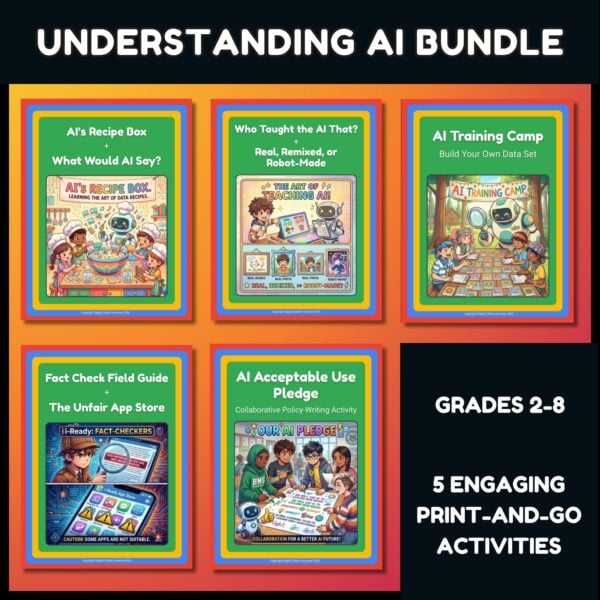
Google Be Internet Awesome AI Companion Bundle | AI Literacy Grades 2-8
· 5 resources · save 33% →
 Your students click, rate, type, and swipe every day. Do they know they're teaching AI when they do?
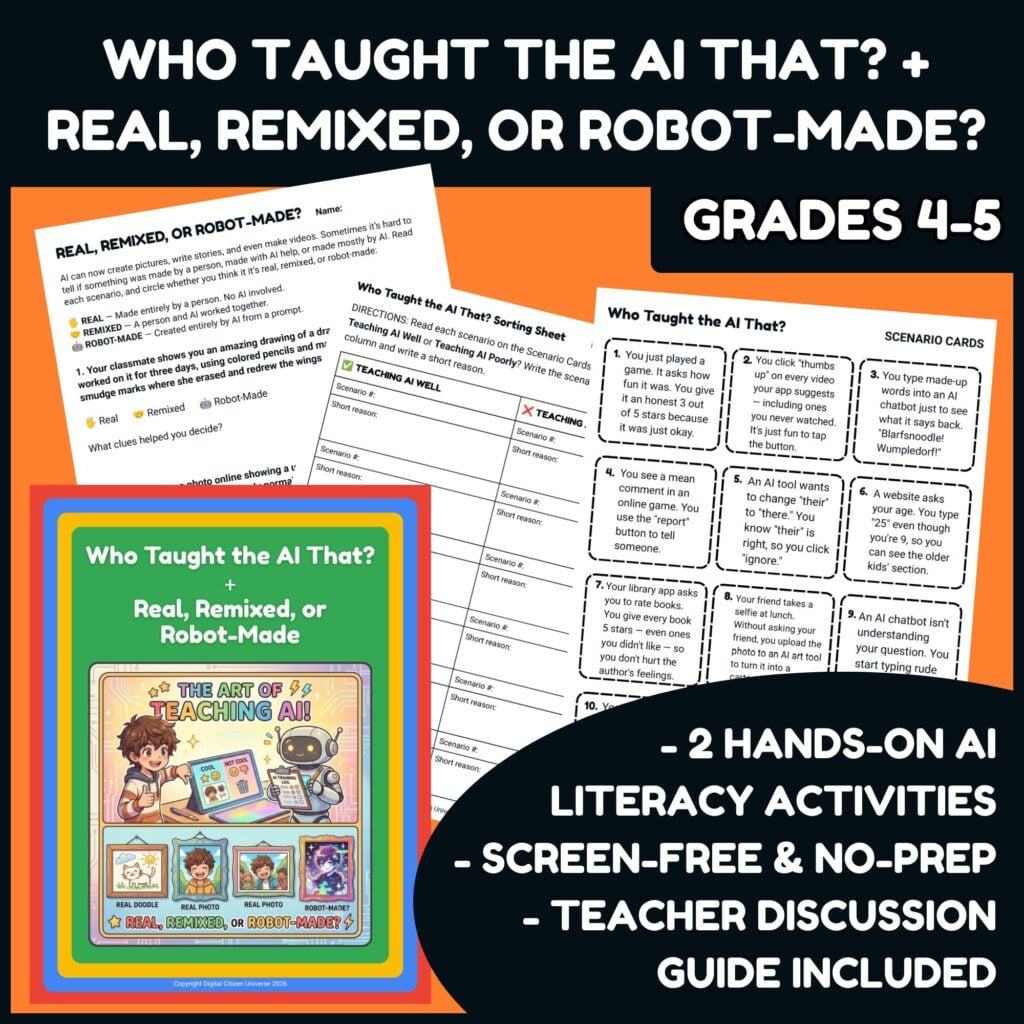
This set has two screen-free activities for grades 4-5 about how people and AI shape each other.
 Who Taught the AI That? (10 to 15 minutes)
Students sort 12 everyday scenarios into "Teaching AI Well" or "Teaching AI Poorly" and write a short reason for each:
 You rate a game an honest 3 out of 5.
You tap thumbs up on every video, even ones you never watched.
 You upload a friend's selfie to an AI art tool without asking.
A few are meant to be debatable, and the answer key has notes for those.
 Real, Remixed, or Robot-Made? (15 to 20 minutes)
Students read 10 scenarios and decide whether each thing was made by a person (Real), by a person with AI help (Remixed), or entirely by AI (Robot-Made). Then they write the clues that helped them decide:
 A realistic photo of a unicorn in a backyard
 A dragon drawing with smudges where the wings were erased and redrawn
 A perfect book report finished in 10 minutes, full of words the student never uses
The last scenario introduces deepfakes at a level that fits grades 4-5.
Everything is on paper, and the two activities work together in one class period or on separate days. The Activity Guide includes notes for using them at home.
 Use it on its own or as a companion
You don't need any other curriculum to use these activities. If you teach Google Be Internet Awesome: Understanding AI, they give students hands-on practice with Lesson 2, "Digital Citizenship and AI," and its ideas about helping AI learn and figuring out what's trustworthy.
 Part of the Be Internet Awesome AI Companion Bundle
This is one of five AI literacy activities for grades 2-8 in my Be Internet Awesome AI Companion Bundle. Get all five for $10 instead of $15.
 Standards Connections
Connects to CSTA E4-ALG-ML-02 (2026) and its closest 2017 code, 1B-DA-07: students connect what people feed an AI to the results it gives back.
Connects to CSTA E4-DAT-IM-11 (2026) and its closest 2017 code, 1B-IC-21: students think about how data about people, like ratings, ages, and photos, affects them, and discuss using other people's work and pictures without permission.
Also connects to ISTE 1.3b (Knowledge Constructor): students evaluate where content came from and whether to trust it.
This resource is not affiliated with, endorsed by, or sponsored by Google. Be Internet Awesome is a program of Google (https://beinternetawesome.withgoogle.com).
 Join the Digital Citizen Universe
Want help teaching your kids and students to be thoughtful digital citizens? Join my email list with the form in the sidebar, and you'll be the first to hear about new resources. Questions? Email hello@digitalcitizenuniverse.com.
Format
PDF
✓ 22 scenarios kids will recognize from their own lives
✓ Shows how everyday clicks and ratings teach AI
✓ Practice spotting AI-made pictures, writing, and video
✓ Remixed category for when people and AI work together
✓ Answer keys with notes for the debatable scenarios
✓ No devices or internet needed
✓ 1-page Activity Guide with classroom and home notes
✓ 12 Scenario Cards and a Sorting Sheet
✓ 2-page Who Taught the AI That? answer key
✓ 3-page Real, Remixed, or Robot-Made? worksheet
✓ 2-page Real, Remixed, or Robot-Made? answer key
✓ Teacher Discussion page with talking points
Do students look at real AI images or videos?
No. Every scenario is described in words, so students practice the thinking without any screens.
Do I need to teach Google Be Internet Awesome first?
No. The Activity Guide introduces each idea, so the activities work on their own.
What if students disagree about an answer?
That's expected for a few scenarios. The answer keys explain the best answer and give notes for the debatable ones.
Can I use this at home?
Yes. Read the cards together and sort them out loud, then try "Real, Remixed, or Robot-Made?" on something you see online together.
Questions
Questions about this resource
Wondering if this is the right fit before you buy? See what other shoppers asked, or ask Elizabeth your own. You don’t need to have bought anything.
Sign in to ask a question
Sign in so Elizabeth’s answer can reach you. You don’t need to have bought anything from Digital Citizen Universe.
What Teachers Are Saying
No reviews yet — be the first to leave one.
Stay in the Loop
Join the Digital Citizen Universe Email List
More from this Store
Shop Now →
Live Well · Teach Well
Shop TeacherStore Goods