
You May Also Like
Suggested Resources by Page & Plot
Store Category · Teacher Resources · Lesson Planning
Romeo and Juliet — Working With AI: A Literary Essay Workshop | 9th Grade ELA
by
 Page & Plot
$4.95
Your students are already using AI. This workshop teaches them to use it responsibly — as a thinking tool they interrogate, not a shortcut they accept.
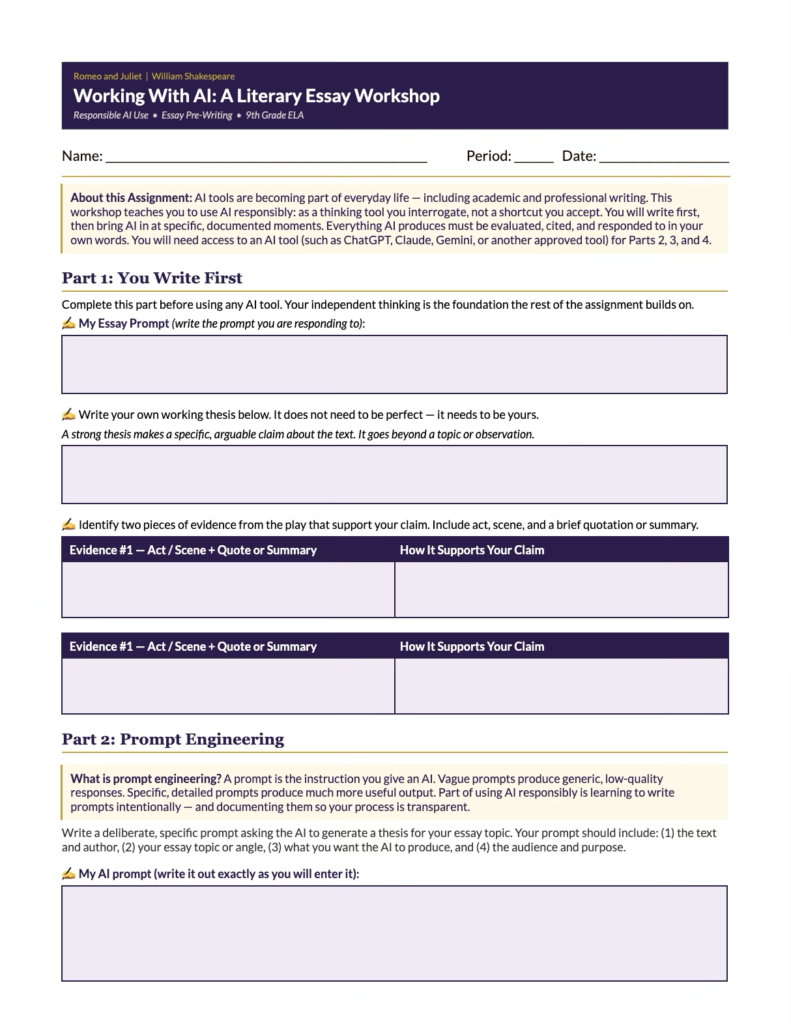
Working With AI: A Literary Essay Workshop is a structured, five-part activity that guides 9th grade honors and academic students through a documented, ethical process of using AI to strengthen their literary argument writing. Students write first, bring AI in at specific moments, evaluate everything it produces, and reflect on what the experience reveals about AI's limitations with literary analysis.
This resource works as a standalone assignment or as an add-on to any complete Romeo and Juliet unit. It is compatible with all three essay prompts (Fate vs. Free Will, Who Is Most Responsible?, Parental Authority) and requires no special technology beyond access to any free AI tool (ChatGPT, Claude, Gemini, or similar).
What's Included
Part 1: You Write First — Students write their own working thesis and identify two pieces of textual evidence before touching any AI tool. This establishes an independent baseline and ensures students cannot simply launder AI output as their own work.
Part 2: Prompt Engineering — Students write a deliberate, specific AI prompt — including text, author, topic, and purpose — and document it exactly as entered. A reflection prompt asks students to articulate what they chose to include or leave out and why.
Part 3: Generate & Evaluate — Students paste the AI's thesis into a designated response box and score it against four criteria: Arguability, Specificity, Textual Grounding, and Sophistication. Students then write a synthesized revised thesis that draws on the strengths of both versions.
Part 4: AI as Devil's Advocate — Students share their revised thesis with AI and ask it to argue against their position. They document the counterargument, evaluate its use of textual evidence, write a rebuttal, and produce a final hardened thesis.
Part 5: Reflection & Attribution — Four structured reflection sub-prompts ask students to evaluate what AI did well, where it fell short, what its limitations reveal about literary analysis, and whether the process changed their argument. Closes with a required dual citation block modeled on MLA AI citation format — students document the exact prompt used for each interaction.
This resource is ideal for:
- 9th grade honors or academic ELA classes reading Romeo and Juliet
- Teachers introducing responsible AI use alongside existing writing instruction
- Districts or departments looking for a model assignment that documents student AI use transparently
- Any teacher who wants students thinking critically about AI — not just using it
Format
Google Apps
Questions
Questions about this resource
Wondering if this is the right fit before you buy? See what other shoppers asked, or ask Rebecca your own. You don’t need to have bought anything.
Sign in to ask a question
Sign in so Rebecca’s answer can reach you. You don’t need to have bought anything from Page & Plot.
What Teachers Are Saying
No reviews yet — be the first to leave one.
Stay in the Loop
Join the Page & Plot Email List
Page & Plot
My Experience
I’m Rebecca Persad, a high school English teacher and resource creator with a background in English, business, marketing, and graphic design. I create classroom-ready ELA resources that combine strong literary analysis, clear organization, and polished visuals. My materials are designed to help teachers save time while giving students meaningful ways to analyze character, theme, symbolism, conflict, and writing.
Teaching Style
My teaching style is structured, visual, and discussion-based. I like lessons that help students move beyond plot summary and into deeper thinking through quote analysis, character tracking, gallery walks, creative projects, discussion, and evidence-based writing. I believe literature lessons should be clear, engaging, and a little beautiful, too.
Awards & shining teacher moments
One of my favorite teaching moments is watching students connect with literature in a way that surprises them. I especially love when a quiet student finds their voice during a discussion, gallery walk, creative project, or writing conference. Those moments remind me that students often need the right entry point into a text, and that’s what I try to build into my resources.
My own education history
I have a bachelor’s degree in Business Management and Marketing/English, a master’s degree in Education, and a background in graphic design. I’ve also spent 12 years as a yearbook adviser, which has shaped the way I create resources that are both visually polished and practical for the classroom.
Join the Page & Plot Email List
More from this Store
Shop Now →
Live Well · Teach Well
Shop TeacherStore Goods