This resource does not include the full text of Jane Eyre. It is designed to accompany your classroom reading of Charlotte Brontë’s novel. References to Wide Sargasso Sea and Gilbert & Gubar’s The Madwoman in the Attic are provided as contextual framing within the activity sheets and do not reproduce substantial portions of either text.arlotte Brontë’s Jane Eyre with a complete, ready-to-use 20-day AP Literature unit that moves students from first impressions of the novel toward sophisticated literary argument — analyzing moral identity, Gothic psychology, power and autonomy, and the critical frameworks that make Jane Eyre one of the most contested novels in the British canon.
This unit includes a 20-day pacing guide, a 23-slide instructional slideshow, 12 character posters, 17 student activity sheets, an AP essay rubric mirroring College Board scoring criteria, a higher-order unit quiz with a complete teacher answer key, and a unit resource guide with AP standards alignment. The unit is built around three essential questions that drive every activity, discussion, and writing task from Day 1 through the final assessment: How does Brontë construct a morally independent identity through Jane? What does Jane’s development reveal about Victorian society? And who — or what — threatens genuine female autonomy?
Students will analyze the Gothic mode as a vehicle for psychological realism, apply feminist, Marxist, and postcolonial critical frameworks to specific moments in the novel, engage with Sandra Gilbert and Susan Gubar’s landmark argument about Bertha Mason as Jane’s psychological double, examine Jean Rhys’s Wide Sargasso Sea as a postcolonial response to Jane Eyre, develop AP-style thesis statements using three distinct thesis models, construct a line of reasoning for a full literary argument essay, and prepare for and participate in a Harkness-format Socratic seminar on Jane’s final autonomy.
All student activity sheets are formatted with table cells for student responses, making this unit fully compatible with Google Classroom, Canvas, Schoology, and other digital platforms.
What’s Included
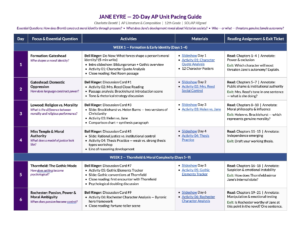
- 20-Day Pacing Guide — daily focus question, bell ringers, step-by-step activities, reading assignments, and exit tickets for every class period
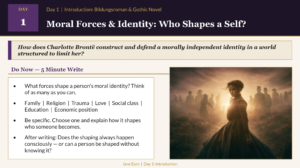
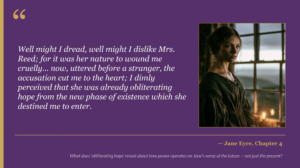
- 23-Slide Instructional Slideshow — context slides, close reading annotation tasks, discussion card displays, AP skill focus slides, two-column character comparison slides, and quote slides for key passages throughout the novel
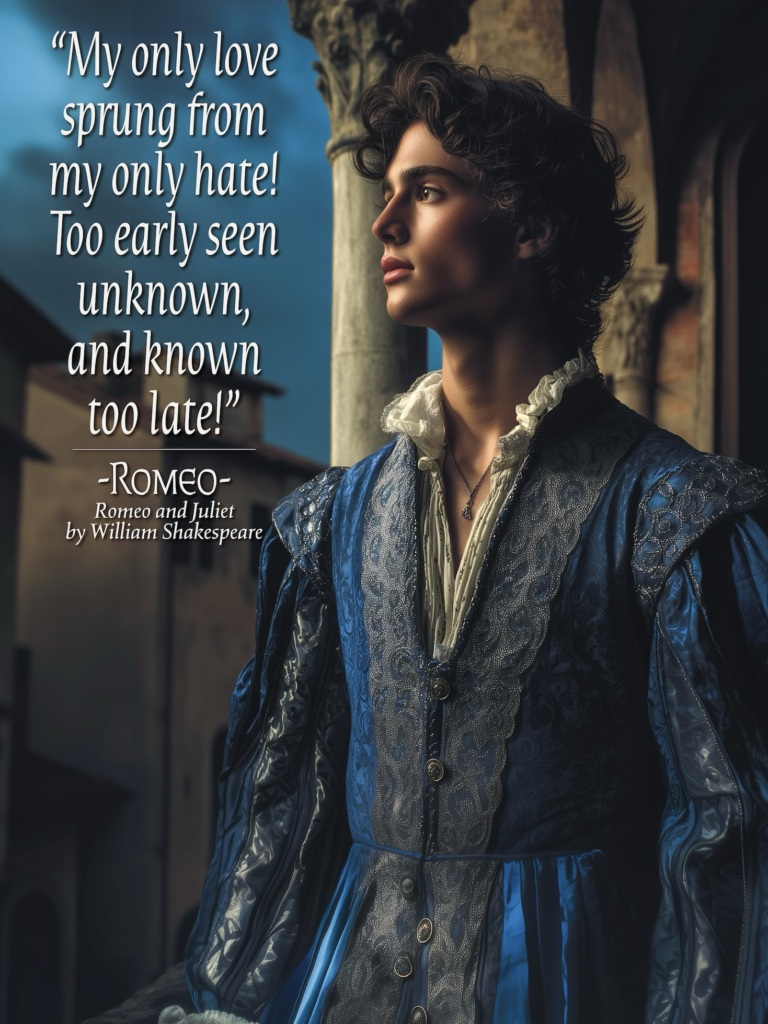
- 12 Character Posters — full-cast posters for gallery walk and character analysis activities
- Activity 1: Character Quote Analysis — four-part close reading: contextual framing, diction analysis, tone, moral philosophy, and a full AP argument paragraph
- Activity 2: Mrs. Reed — Social Control & Domestic Oppression — passage-based close reading with language and power analysis, tone and rhetorical strategy, narrative perspective, and AP synthesis paragraph
- Activity 3: Helen vs. Jane — Endurance, Resistance & Moral Philosophy — philosophical comparison chart and the synthesis question: does Jane adopt, reject, or transform Helen’s philosophy?
- Activity 4: Thesis Practice — Moral Influence & Identity Formation — three AP thesis types (interpretive, evaluative, complexity-forward), weak vs. strong thesis diagnosis, and line of reasoning development
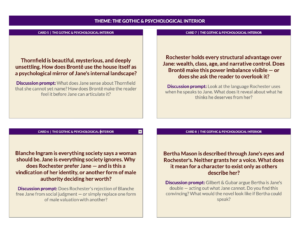
- Activity 5: Gothic Elements Tracker — five Gothic conventions tracked for psychological effect, hidden truth, and thematic function; Bertha as Gothic focal point; AP synthesis paragraph
- Activity 6: Rochester — Passion, Power & the Byronic Hero — Byronic hero framework, power imbalance analysis, redemption debate, and AP complexity paragraph
- Activity 7: Blanche vs. Jane — Performance, Class & Authentic Identity — structural foil analysis across six categories, language and performance close reading, and AP argument paragraph
- Activity 8: Bertha Mason — Psychological Double, Colonial Other & the Madwoman — three critical frameworks (psychological, feminist, postcolonial), Wide Sargasso Sea connection, and AP critical position paragraph
- Activity 9: Crisis Close Reading — The Failed Wedding — annotation, analysis chart, syntax and moral structure analysis, and AP timed paragraph on why Jane leaves
- Activity 10: Rochester vs. St. John — Competing Moral Ideologies — comparison chart, St. John’s proposal close reading, AP argument paragraph, and complexity move
- Activity 11: Rivers Sisters — Alternative Models of Womanhood — evidence chart, structural function analysis, and the question of what Diana and Mary provide that Thornfield cannot
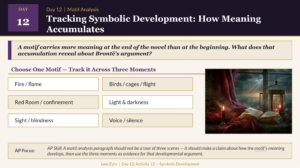
- Activity 12: Tracking Symbolic Development — motif selection, three-moment tracking chart across early/middle/late novel, synthesis paragraph, and craft analysis
- Activity 13: Socratic Seminar Preparation (Harkness Format) — opening claim, evidence dossier, counterargument preparation, discussion build-on, and post-seminar reflection
- Activity 14: AP Literary Argument Essay Planning — full AP scaffold with prompt unpacking, thesis checklist, line of reasoning framework, evidence planning, and sophistication move development
- Activity 15: Critical Lenses — Feminist, Marxist & Postcolonial — three frameworks applied to specific moments in the novel with evaluative paragraph on which lens the novel most resists
- Activity 16: Intertextual Criticism — Gilbert & Gubar & Wide Sargasso Sea — close engagement with both critical texts, textual analysis, and a critical synthesis paragraph on what Jane Eyre cannot see
- Activity 17: AP Timed Writing Packet — three AP-style Q3 prompts (Moral Identity & External Forces; The Gothic & Psychological Realism; Power, Autonomy & the Conditions of Freedom) with pre-writing structure, full essay space, and AP self-assessment
- AP Literary Argument Essay Rubric (50 points, landscape) — mirrors AP Lit scoring criteria: Row A Thesis (0 or 8 pts), Row B Evidence & Commentary (0–32 pts), Row C Sophistication (0 or 8 pts), plus craft/conventions and prewriting/process; includes scored examples of what earns and does not earn each criterion
- Unit Quiz + Teacher Answer Key — 5-item matching (character structural function), 4 select-all-that-apply questions, 8 higher-order multiple choice questions, and 2 AP-style short answer questions; full rationales for every item in the answer key
- Complete Unit Resource Guide — master index with AP standards alignment chart, activity-by-activity teacher notes, and bundle overview
Skills Covered
Students will practice:
- close reading of prose — diction, syntax, tone, and narrative perspective
- AP Literary Argument essay construction (Q3 — line of reasoning, sophistication point)
- AP-style thesis development across three thesis types
- evidence selection and genuine analytical commentary
- character analysis as a vehicle for thematic argument
- Gothic mode analysis — setting as psychological state
- motif and symbolic development tracking across a full novel
- applying feminist, Marxist, and postcolonial critical frameworks
- intertextual analysis — engaging with literary criticism and secondary texts
- Harkness-format Socratic seminar preparation and participation
- timed writing and AP self-assessment
- comparative character analysis — foil relationships as structural argument
- MLA citation and academic writing conventions
Great For
- Jane Eyre AP Literature unit (12th grade)
- British literature unit
- Victorian literature and context study
- Gothic novel analysis
- AP Literature and Composition exam preparation
- feminist literary criticism and critical theory introduction
- postcolonial literature and Wide Sargasso Sea connection
- Socratic seminar and Harkness discussion
- literary argument essay and timed writing preparation
- close reading and prose analysis (AP Lit Q2 preparation)
- intertextual and secondary source analysis
- high school ELA (grades 11–12, honors or AP)
Why Teachers Love It
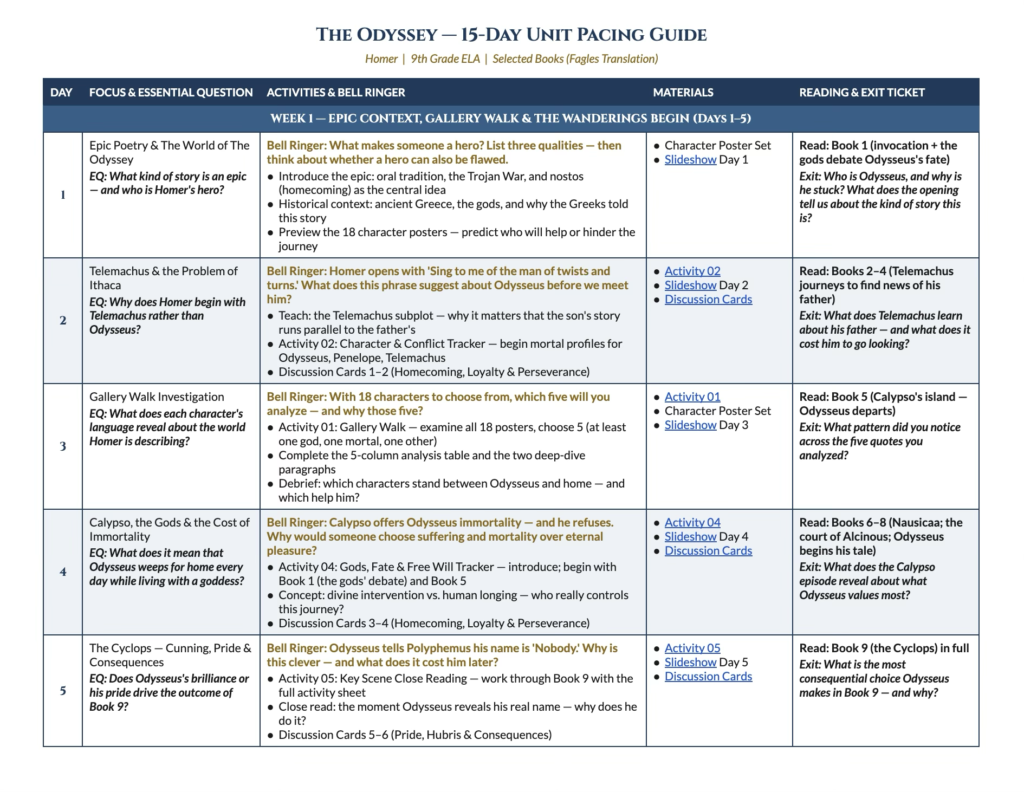
This unit is designed to be comprehensive, rigorous, and classroom-ready at the AP level. The 20-day pacing guide walks you through every class period with a daily focus question, bell ringers, step-by-step activities, reading assignments, and exit tickets — so planning is already done.
What makes this unit stand out is the depth of its critical framework integration. Most Jane Eyre units treat the novel as a romance with feminist overtones. This unit treats it as the contested, complex text it actually is — one that has generated landmark works of literary criticism precisely because it rewards and resists multiple readings simultaneously. Activity 8 (Bertha Mason) is the unit’s centerpiece: it walks students through the psychological double argument (Gilbert & Gubar), the feminist reading, and the postcolonial critique (Jean Rhys / Wide Sargasso Sea) as three distinct frameworks — then asks students to argue which reading is most illuminating and why. It is consistently the activity that produces the strongest student writing in the unit.
Activity 16 goes further, giving students direct engagement with Gilbert & Gubar’s argument and the Wide Sargasso Sea context in enough depth to use both in a literary argument essay. Students who complete this unit are genuinely prepared for AP Lit Q3 — not just drilled on essay structure, but practiced in the kind of interpretive thinking the exam rewards.
The AP essay rubric is built on the actual AP Literature scoring criteria — Row A Thesis, Row B Evidence & Commentary, Row C Sophistication — translated into a classroom-usable 50-point format with scored examples. The quiz is designed to reward higher-order thinking: the matching questions ask students to identify characters’ structural function in the novel’s argument, not just recall plot. The eight multiple choice questions include items on Gilbert & Gubar, postcolonial reading, line of reasoning, and what earns the AP thesis point — the kind of questions that distinguish students who understood the novel from students who read it.
The Harkness-format Socratic seminar preparation (Activity 13) requires students to arrive with a defensible opening claim, an evidence dossier of three quotations with analysis, a prepared counterargument response, and a build-on point for a peer’s likely position. The post-seminar reflection is built into the same document. Strong seminar participation does not happen without preparation — this activity structures exactly what that preparation requires.
Suggested Use
- Day 1: Character poster gallery walk, Character Quote Analysis, Bildungsroman and Gothic context
- Day 2: Mrs. Reed close reading — language, power, and domestic oppression
- Day 3: Helen Burns vs. Jane — philosophical contrast and moral development
- Day 4: Miss Temple and rational justice — Thesis Practice activity and AP thesis workshop
- Day 5: Gothic Elements Tracker — Thornfield as psychological landscape
- Day 6: Rochester Character Analysis — Byronic hero framework and power imbalance
- Day 7: Blanche vs. Jane — foil analysis and performance vs. authenticity
- Day 8: Bertha Mason — three critical frameworks and Wide Sargasso Sea context
- Day 9: Crisis Close Reading — the failed wedding and moral turning point
- Day 10: Rochester vs. St. John — competing moral ideologies and AP argument paragraph
- Day 11: Rivers Sisters — alternative models of womanhood and structural function
- Day 12: Tracking Symbolic Development — motif workshop and synthesis paragraph
- Day 13: Critical Lenses — feminist, Marxist, and postcolonial frameworks
- Day 14: Intertextual Criticism — Gilbert & Gubar and Wide Sargasso Sea analysis
- Day 15: Motif synthesis and guided writing — peer thesis and line of reasoning review
- Day 16: Socratic Seminar Preparation (Harkness format)
- Day 17: Socratic Seminar — full period discussion and post-seminar reflection
- Day 18: AP Essay Workshop — line of reasoning, sophistication point, planning template
- Day 19: AP Timed Writing — pre-writing, full essay, and AP self-assessment
- Day 20: Unit quiz, final essay submission, closing discussion, and unit reflection
Please Note
This is a digital resource. No physical item will be shipped.